Website: https://erasmus-plus.ec.europa.eu/projects/search/details/2023-3-LT02-KA153-YOU-000174046
Start date 24-03-2024
End date 23-07-2025
Budget:
Coordinator: ASOCIACIJA TAVO EUROPA
Partner: European Multidisciplinary Organization for Training and international Consulting (AT) , SEIKLEJATE VENNASKOND (EE) , Asociatia KASTA MORRELY (RO) , Young Folks LV (LV) , ICSE & CO (IT) , ELIX – PROGRAMMATA ETHELONTIKIS ERGASIAS (EL) , Brisa Intercultural (ES) , SDRUZHENIE WALK TOGETHER (BG) , Stowarzyszenie LEVEL UP (PL)
Objectives
The primary goal of this project was to empower youth workers with knowledge, tools, and the practical experience necessary to address societal challenges through conflict transformation and emancipatory practices. In this project, we utilize the definition of “emancipatory approach” as one that enhances understanding about how power works to limit opportunities, create marginalization, and perpetuate inequities. Current approaches to cultural and social competency do not adequately equip youth workers to address the complex factors that shape inequality and marginalization within society, and do not properly equip them to handle conflict that are likely to face due to social and cultural confrontations when working with very diverse and marginalized communities.
By introducing innovative methodologies and fostering international collaboration, we aimed to build the capacity of participants to promote inclusivity, understanding, and sustainable solutions within their local communities. Using simulation-based learning tools such as the “MORE” Boardgame and “DIVINI” simulation, we were able to simulate real-world challenges, enabling participants to experiment with strategies for conflict resolution, negotiation, and collaboration in a safe, controlled environment. In doing so, we also encouraged cross-cultural collaboration by bringing together participants from diverse backgrounds and experiences. This fostered mutual learning and laid the groundwork for long-term partnerships between youth organizations across Europe
Specificly the following objectives were set:
– explore two innovative educational tools which can be used to raise the conflict transformation competences of youth workers and their target groups and accompany them in developing their own initiatives for social and cultural justice;
– text and pilot new tools and methods as well as innovative approaches to increase the quality of youth work;
– deepen understanding of concepts related to conflict transformation and analyse the phenomenon of social cultural conflicts at multiple levels;
– develop a bystander sense of intervention to address injustice and promote emancipation from inequality;
– provide a space for the transfer of the acquired knowledge and competences to the local youth work reality;
– develop follow-up projects on local and international level in the field of conflict transformation
Implementation
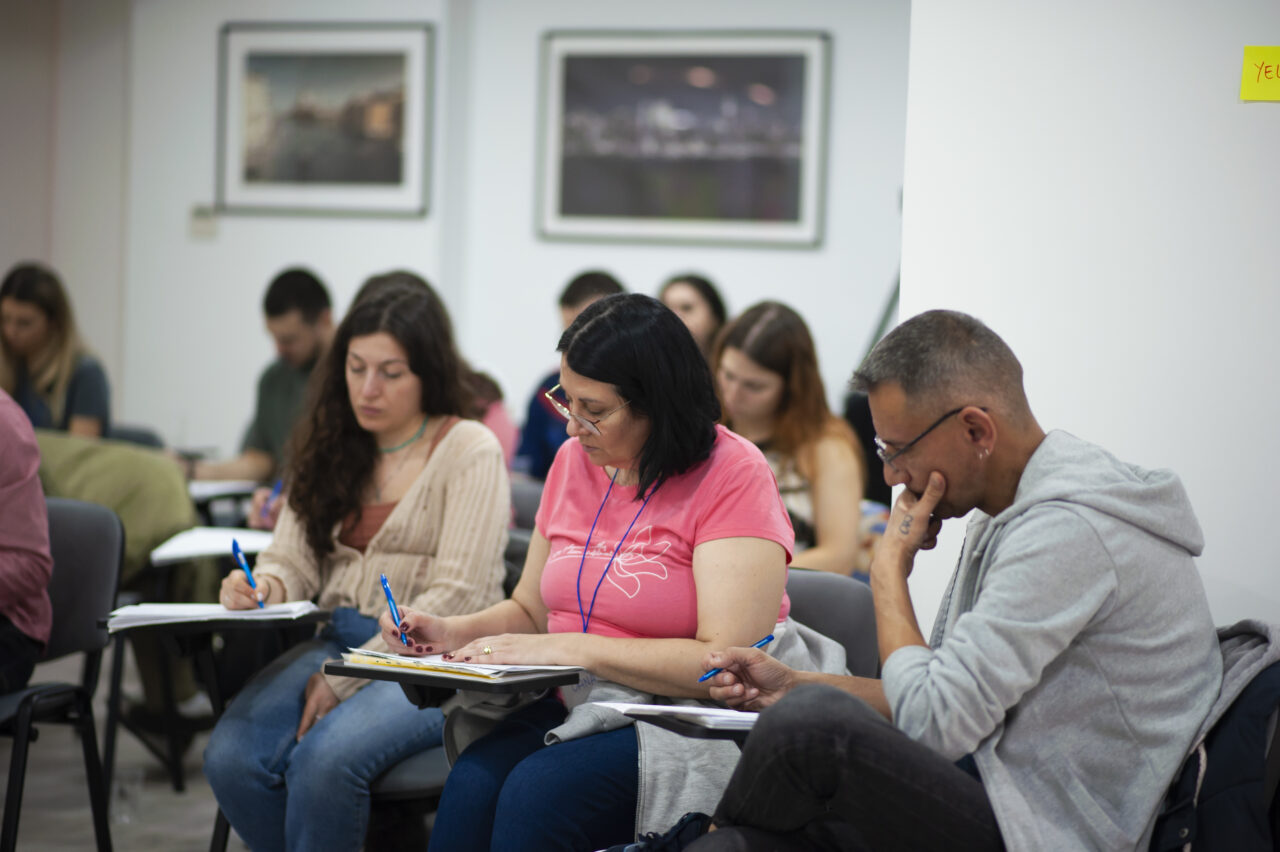
A total of 33 youth workers from 9 different countries (Bulgaria, Latvia, Lithuania, Spain, Greece, Italy, Estonia, Romania and Poland) were involved in the activities; the age range was 20-35, with also but we also a couple of older participants, bringing a more structured, well-rounded insights from their environments, where they are working, studying or observing a community. All the participants proved to be interested in the topic, already having some experience in non-formal education and with working or volunteering with young people.
The project comprised a variety of structured, interactive, and experiential activities designed to meet the objectives of equipping youth workers with tools for conflict transformation and emancipatory practices. These activities were tailored to ensure a balance of theoretical understanding, practical skill-building, and collaborative experiences.
In details, we implemented the following activities:
Ice breaking and Team Building:To foster trust and inclusivity among participants from diverse cultural and backgrounds. It allowed to identified shared traits and interests to build rapport and helped in creating a Code of Conduct to ensure a respectful and productive environment during the training.
Introduction to Training Objectives and Frameworks
We provided clarity of the project’s goal and methodology, exploring in details with participants how those aligned with their countries’ reality, their specific needs, skills and expectations. We used Balaton Analysis to explore participants’ expectations, fears, and motivations using visual metaphors. Youthpass Mandala provided an overview of the Youthpass framework, to guide participants in reflecting on their learning outcomes throughout the training.
Social and Cultural Values Workshop:
To identify cultural dimensions that influence conflict perceptions and behaviours and to deepen participants’ understanding of the fundamental concepts, conflict dynamics and transformation methodologies and to create a shared common ground. Exercise from “Compass – Manual for human rights education” were used to reflect on privileges and social injustice. Johan Galtung’s Conflict Triangle” was also used to explore attitudes, behaviours, and contradictions as key components of conflicts.
Simulation-Based Learning;
On two different days participants experience 2 different but complementary simulation tools:
MORE Boardgame: simulated real-world conflict scenarios and taught negotiation, resource management, and collaborative problem-solving. It allowed to explore the concept of justice, the shift of perceptions and deepening the knowledge of conflict and peace and how communication can be used as a tool of conflict transformation and emancipation
DIVINI Simulation: addressed the issues of radicalization and counter-extremism in a fictional community setting, asking participants to develop and present strategies for preventing extremism. It provided a more comprehensive and strategic way to analyse conflict, and how to apply solutions in real-world local communities.
5) Participatory Methodologies:
Betzavta Method was used to explore dilemmas and conflicts in democratic decision-making, showing how equality and compromise are often in tension during decision-making. Thomas-Kilmann Conflict Transformation Models introduced participants to five conflict-handling styles and a role-playing exercises simulated real-life conflicts, encouraging participants to practice and reflect on different styles.
6) Strategic Planning Workshops:
Participants were equipped with tools for designing, monitoring, and evaluating youth-led initiatives. We included exercise to develop action plan to implement in their local communities during follow-up activities. A Practical session, for monitoring and evaluation designing indicators and assessing impact of social emancipation was also included
7) Reflection and Personal Growth:
To encourage participants to internalize their learning and align it with their professional goals we provided a daily journal to documented key insights and personal reflections; those reflection where then used to fill their personal youthpass.
8) Social and Cultural Activities:
o promote cross-cultural understanding and informal networking we planned 3 cultural evenings, in which participants from different countries shared traditions, music, and food from their culture. Community dinners and informal discussions were also important to strengthen bonds between participants.
9) Final reflection and Closing Ceremony: Participants consolidate learning outcomes, and discussed the transferability to their local contexts, receiving feedback about their follow up ideas. Feedback about the training were also gathered.
We celebrate the achievements of participants, distributing Youthpass certificates and sharing group reflections, final remarks and create networking, sharing contact information and planning future collaboration
Results
The main result was the youth worker training that took place in Markutiskes, Lithuania (Trakai region) between 19 and 26 November 2024 at the La Villa Royale, near Trakai.
The project achieved outstanding results and had a transformative impact on participants, partner organizations, and local communities. By fostering collaboration, equipping youth workers with innovative tools, and promoting inclusive practices, the project created a lasting effect beyond the training course itself. Follow-up activities have been carried out in each country, attracting several times larger audiences, introducing them to emancipatory and conflict transformation methodologies, effectively sharing with more youth workers and stakeholders effective methods, tools and resources. In addition, a toolkit has been developed and update on Salto website.
IMPACT ON PARTICIPANTS:
The project achieved its objectives by equipping youth workers with transformative tools and fostering collaboration among cross-national teams.
Participants demonstrated their ability to facilitate simulations and workshops and left with comprehensive guides for the MORE and DIVINI, having personalized action plans for implementing training outcomes locally in diverse contexts such as schools, NGOs, and local governments.
They were successfully equipped with knowledges and skills in conflict dynamics, conflict transformation, facilitation of simulations, and strategic planning to develop and execute community-based initiative. This enhanced their ability to mediate conflicts, navigate cultural diversity, face discriminations and promote inclusivity in their daily work, reflecting their understanding of how to apply conflict transformation methodologies in diverse contexts.
At a personal level they also growth significantly, increasing their self-reflection skills, developing a better understanding of their own biases, improving communication styles, and increasing their collaboration and networking skills. In fact, some participants established a network for sharing best practices, exchanging ideas, and supporting each other in their professional journeys, also expressing interest in participating in or leading future Erasmus+ projects.
The outcomes extend beyond the training itself, with Participants committed to applying their learning in their local contexts and engaging in future joint initiatives. Some of them initiated peer-to-peer training sessions in their communities, ensuring the ripple effect of the project.
IMPACT ON PARTICIPANTS ORGANISATION:
Partner organisations are committed to integrate the training’s emancipatory practices into their existing programs, leading to more effective interventions, improved capacity building and strengthening their capacity to address complex social challenges. Plans were made for follow-up projects to scale the impact of the training, ensuring the dissemination, sustainability and scalability of the project,
Involved organisation also shared feedback that the project provided an excellent model for cross-cultural training and collaboration, strengthening relationships between organisations and improving their international Networks, enabling smoother cooperation on future projects. In fact, everyone expressed interest in ongoing collaboration, particularly on youth-related issues like inclusion, empowerment, and conflict resolution. New partnerships were also established between youth organisations, resulting in follow-up project ideas to be submitted for future Erasmus+ calls.
IMPACT ON STAKEHOLDERS AND COMMUNITY:
Every member of the participant associations’ network can benefit from the project, as the tools and methodology are free to be shared with everyone, thought the online library and the toolkit shared with the participants.
Local Communities will benefit from the implementation of inclusive youth initiatives by the participants, inspired by the training, that will foster emancipatory and conflict resolution process, involving more youths and youth worker in the process. The simulation tools have proved especially impactful in promoting understanding and reducing tensions in conflict-prone areas, supporting positive community transformation.
In practice, several participants implemented their action plans within weeks of the training, addressing pressing local challenges such as youth inclusion, interfaith dialogue, and environmental disputes. Early feedback from local communities highlighted positive responses to these initiatives. The tools and methodologies shared during the training inspired participants to involve local youth in decision-making processes, fostering empowerment and agency. Further dissemination and follow-up activities will share with more youth worker and youth associations the knowledge, tools and methodology learned increasing the impact of the project on stakeholders and community
