Website: https://erasmus-plus.ec.europa.eu/projects/search/details/2020-1-LU01-KA105-063167
Start date 07-06-2020
End date 06-06-2022
Budget: 58.378,08 €
Coordinator: AMITIES LUXEMBOURG – ARMENIE ASBL
Partner: ASOCIATIA GEYC (RO) , YOUTH ASSOCIATION DRONI (GE) , ASOCIACIJA AKTYVISTAI (LT) , WORLD INDEPENDENT YOUTH UNION (AM) , KINONIKI SINETAIRISTIKI EPICHERISIELLINIKI SYMMETOCHI NEON (EL) , BLUE CHERRY ACADEMY FOR YOUTH AND ADULTS (CY) , Youth Garage e.V. (DE) , ICSE & CO (IT) , Youth for Mobility (NL)
Objectives
Some of the partners of this project met in the study visit “Home” this was a project aimed at establishing a partnership between youth NGOs in different regions working with ethnic and social minority groups (including refugees). So, as a follow-up, we discussed the possibility of a partnership to develop a strategic direction for uniting minority youth action in Europe and minority culture recognition and dissemination activities. During SV, the partners identified a need to know better the countrys’ policies and actions toward the ethnic minority groups that don’t have a kin-state (like Yezidies, Assyrians, Udi, Sami), for being able to develop a further project that will be more need orientated and will bring benefits to NGOs working both minorities/majorities. Based on this need was proposed an LTTC “Participation and citizenship” that aims to promote, support minority young people in diversity promotion activities, strengthen their presence in European programs, and train them to promote their cultural values, as well as the values of the European citizenship in their groups. Citizenship based on rights: civic, political and social. Taking a broad understanding of citizenship implies acknowledging an individual’s personal development and a society’s interior development. An individual and society engage differently with 4 dimensions of citizenship – social/ economic/cultural/political – depending on the way of thinking that is most influential for them at a certain time. Working with citizenship with young people also implies paying attention to the personal development of the individuals and the underlying group development in society. An understanding of these states and dynamics enables youth workers to work with 4 dimensions in such a way as to be able to meet the needs of young people in their specific context. Based on this need were developed the following objectives:
– To raise the quality of education for citizenship and improve active participation of young people in European youth work; – To bring the concept of European Citizenship closer to the spaces that youth work offers for young people to learn to be part of society and to update them with relevant information and know-how for youth workers and educators.
– To discuss and to underline the role of the NGOs and young people on the process of active participation, consolidation and effective citizenship;
-To promote partnerships between the different actors involved in education for citizenship and work out a framework of concepts for education for citizenship together with terminology and to identify skills required for democratic practices in European youth work.
-To raise awareness about the ethnic minorities that don’t have their independent states in the frame of the collective dimension of citizenship;
-To develop a set of guidelines describing the basic skills required for effective citizenship, translation and dissemination of them in 10 involved countries;
– To highlight the role of Erasmus + and the Youthpass in the process of education for citizenship;
– To explore European values and good practices as a common base for future cooperation between NGOs of Caucasus and EU.
LINK TO THE OBJECTIVES OF THE ERASMUS + The project meets the objectives and priorities of the Erasmus+ in the following way: Fosters mutual understanding between young people in different countries; The project fosters mutual understanding between young people in different countries between the Caucasus and the EU as the main theme of the project is HR and ICL.
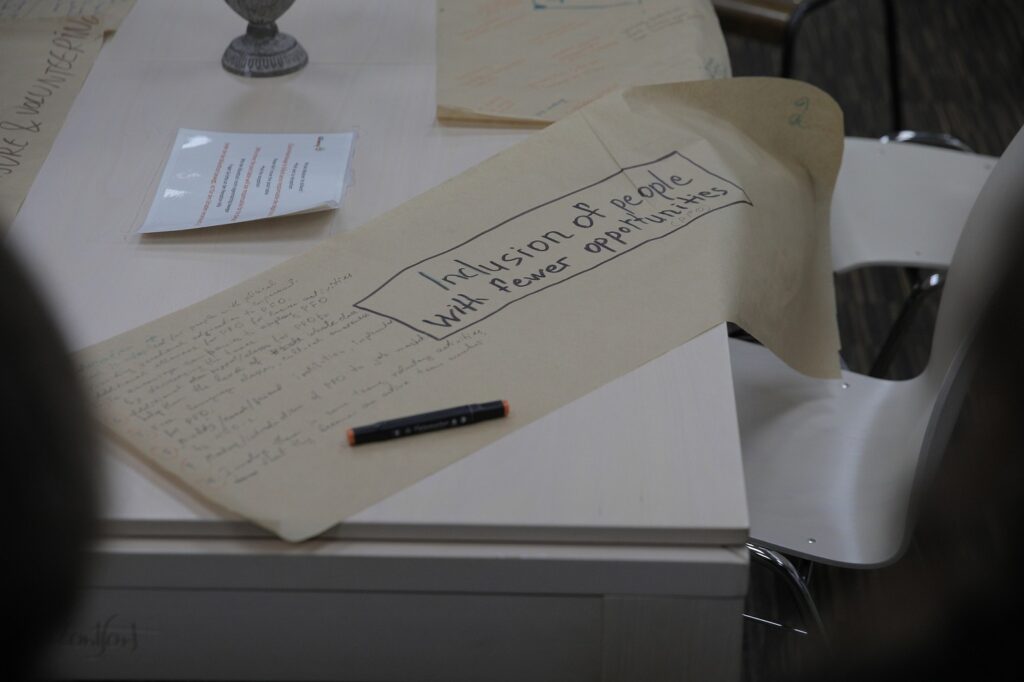
The project involved ethnic/cultural/confessional minorities from 10 countries. ISSUES SEEKING TO ADDRESS The project allowed the participants to learn about youth work reality in Armenia and Luxembourg. As a result, the projects developed at the end of the project correspond to the needs of the young people both in the Caucasus and in the EU states. The activity also provided space for sharing already existing good practices and methods used in minority and HR related projects. These all contributed to the development of the quality of support systems for youth activities and the capabilities of civil society organizations in the youth field. Participation of young people in the project is developed with and by minority young people. Cultural Diversity – Each country is represented by several cultures, so the group of the participants was highly diverse and unique. Inclusion of young people with fewer opportunities – involved minorities predominantly live in isolated rural arias and have a lack of access to information and opportunities.
Implementation
The project initially had three phases: The first residential meeting – training course was implemented in Esch-Sur-Alzette, Luxembourg, from the 6th to 15th December 2021. The first residential meeting aimed to work out a framework of concepts for education for democratic citizenship together with the appropriate terminology and to identify the basic skills required for democratic practices in European youth work. The “Homework” part of the project was implemented in the countries of the partners involved in the project. It was a period when participants implemented local activities connected with the project topic. The projects were planned with the help of trainers.
The second residential meeting training course was implemented in Yerevan, Armenia, from the 4th to the 13th of April 2022. The aim of this meeting was to identify different methods and ways of learning, teaching and training, to build up a network of multipliers, adult educators, teachers and trainers in education for democratic citizenship, to exchange information and experience in the field of education for citizenship and to create fora for reflection and discussion. Both meetings were planned to be held in 2020, but it was postponed several times because of pandemics. The LTTC gathered 34 participants for each of the project parts (all in all 68).
Although due to the excellent cooperation of partner organisations and motivated participants, all parts were successfully implemented. The project gathered partners from 10 Program and Partner countries (Luxembourg, Armenia, Lithuania, Romania, Greece, Georgia, Cyprus, Italy, Netherlands, and Germany) interested in working with youth and minority issues.
Results were disseminated via social media pages of partners and participants, local media, mailing lists, partners’ networks,s etc. As a continuation, new projects based on human rights promotion and inclusion were planned. One of the KA1 projects was developed by ALA in cooperation with some partners from this project and was applied under Erasmus + Programme and was approved by the Luxembourgish NA Anefore. Another KA1 project about inclusive youth work is ready for the application process to Cyprus NA in autumn 2022.
Results
The qualitative assessment with an evaluation form at the end of 2 residential meetings of the project showed that the main objectives set initially for the project can be considered to be gained. Particularly, participants’ planned and implemented local follow-up projects that were an indicator of involvement and choice of learning methodologies. Participants were more convenient at the end of the project to organize more initiatives supporting the active participation of young people in decision-making processes on local, national and regional levels. During two residential activities and an online meeting, participants learned and shared knowledge and stories about the topic. On the personal level – participants changed their attitude first of all towards themselves, knowing that they’re the ones who are well equipped with the skills to involve young people in their activities and motivate them to act as active citizens. As a result of our project, most of the participants had great professional and personal achievements. Participants from Latvia organized a Living Library event based on a model they learned and saw in Luxembourg during the TC. Participants from Georgia implemented a 1-day seminar for the high-school students sharing the theoretical and practical tools and knowledge learned during the TC PC. Participants from the Netherlands initiated a project promoting a volunteering experience with the aim of supporting newcomer migrant people. Participants from Cyprus implemented workshops for the other members of their organization.
Among other results, the project team finds it notable also the 2 KA1 projects developed involving the partners of the PC TC based on the needs identification methods presented by the sociology expert during the first TC. Media campaign materials also were created by the participants of both TCs, and one of them was shared widely as a part of the Human Rights Day 2021 events in Luxembourg.
